
Engineering drawings contain some of the most valuable information in an industrial plant.
Process flow diagrams and piping & instrumentation diagrams (P&IDs) show how pipes, valves, pumps, vessels and safety systems connect. They underpin inspection planning, safety studies, maintenance and change management.
But for most organisations, that information is still trapped in PDFs, scans and drawings that only experienced engineers can reliably interpret.
AI is starting to change that.
The interesting part is not simply whether AI can “read” an engineering drawing. It’s whether it can answer questions about that drawing accurately enough to be useful in safety-critical, highly regulated environments.
And that is where the approach matters.
The difference between reading a drawing and understanding it
A general-purpose AI model can look at a drawing and identify labels surprisingly well.
The problem is that engineering drawings are not really documents in the usual sense. Their meaning comes from relationships.
- Which pipe connects to which vessel?
- What sits downstream of a valve?
- Which valves isolate a particular piece of equipment?
- How do control loops interact?
A drawing may contain hundreds of similar symbols, lines crossing one another, off-page references and conventions that vary across companies and decades. Legacy drawings may also be scanned or hand-drawn.
That makes them difficult for general-purpose AI.
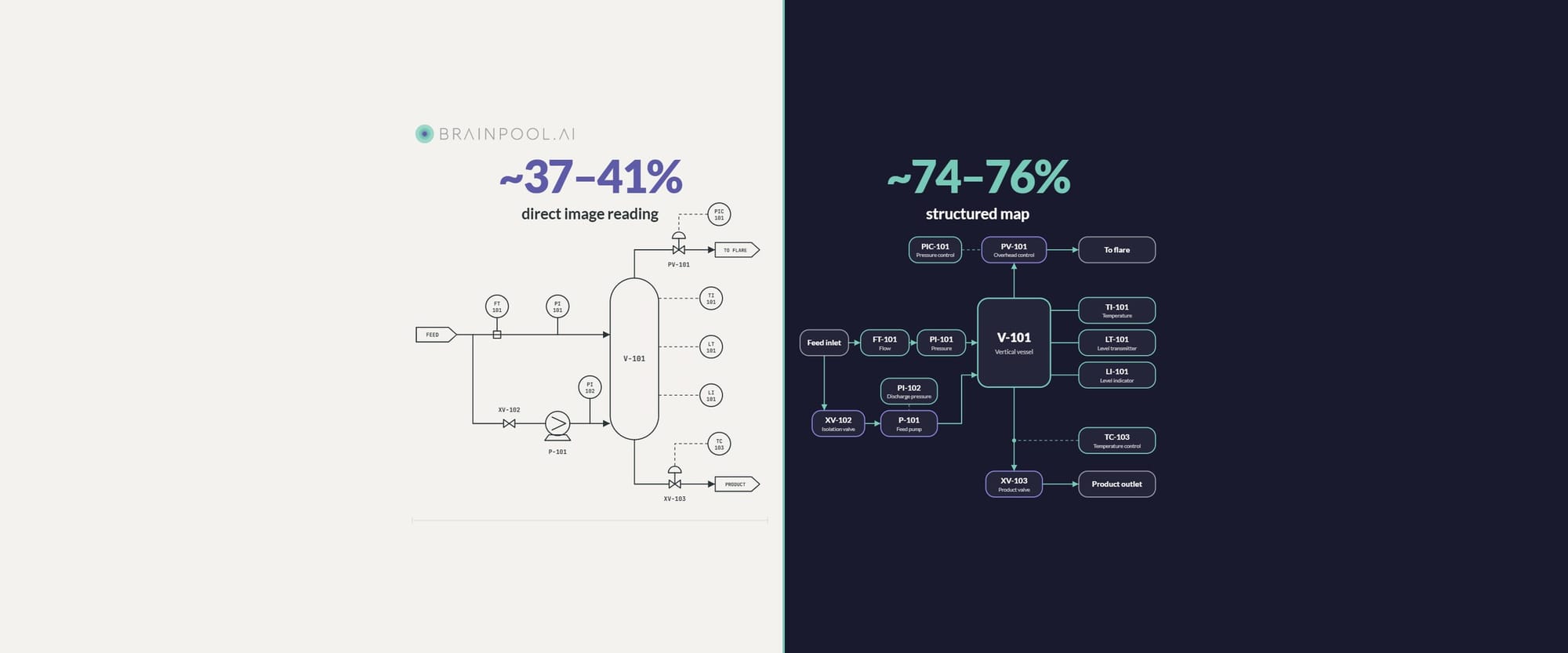
In recent research from TCS, models answering 3,000 connectivity questions directly from drawing images achieved roughly 37–41% accuracy. When the drawing was first converted into a structured map and the AI answered from that map, accuracy increased to roughly 74–76%.
That difference is important. For TIC businesses, an answer that is plausible is not enough.
It needs to be reliable, checkable and traceable back to the evidence.
So what actually works?
The research points towards a simple principle:
The principleMap first. Ask questions second.
Instead of asking an AI model to interpret the drawing from scratch every time, the drawing can first be converted into a structured representation of the plant. That process has three stages.
Extract
Convert the drawing into a structured map of equipment, symbols and connections using a combination of AI and engineering rules.
Verify
Have qualified people review and approve that map before it is relied upon.
Query
Let an AI assistant answer questions using the verified map — and require it to show where the answer came from.
The result is not just an AI-generated answer. It is an answer based on a defined, reviewable representation of the original drawing.
Why this matters for Testing, Inspection & Certification
For Testing, Inspection & Certification organisations, this is not just an interesting application of computer vision.
Engineering drawings sit behind a huge amount of safety, inspection and compliance work. They feed into areas such as:
- HAZOP and other hazard studies
- Mechanical integrity programmes
- Management of change
- Risk-based inspection planning
- Inspection and certification activities
When the underlying information is difficult to interrogate, the work built on top of it becomes slower and harder to scale.
There is also a practical capacity problem.
Engineer-hours to manually redraw one project’s P&IDs in a published case study — against about 200 with automated conversion (Kang et al., 2019).
For organisations dealing with thousands of drawings, that quickly becomes a significant resource requirement. And the expertise needed to interpret complex drawings correctly is itself scarce.
That means the opportunity is not simply to automate a task. It is to make hard-won technical knowledge more accessible to the people who need it, while keeping experienced professionals in control.
The trust problem is bigger than accuracy
For TIC organisations, “the AI got it right” is only part of the story. The next question is:
How do you know it got it right?
That is where three principles become critical.
Human sign-off
AI can identify, structure and suggest. Qualified people still review and approve the information before it becomes something the organisation relies on.
Traceability
Every answer tied back to a specific source — ideally the drawing, revision and location it came from. An evidence trail, not a black-box response.
Consistency
AI outputs can vary. A verified structured map is a stable source of truth, so the same question gets the same answer — checked against the same information.
For a sector built around independence, competence and evidence, those safeguards are not an afterthought. They are the point.
The wider AI lesson
Engineering drawings are a useful example of a broader problem with AI adoption. Putting a generic AI model in front of a complicated business process does not automatically make that process intelligent.
The value comes from giving AI the right context. In this case, that means:
- The drawing
- The structure
- The engineering rules
- The verified knowledge
- The answer
Other research supports the same general direction.
The exact figures vary by task and methodology, but the broader message is consistent: structure and engineering context matter.
What this could mean for TIC
The sector already has many of the ingredients needed to make this work. TIC organisations understand verification. They work with standards, evidence, audit trails and controlled processes every day.
That gives the industry an advantage when thinking about AI adoption. The question is not whether AI should replace the expert. It is how AI can help the expert work with more information, faster, without weakening the controls that make the work trustworthy.
For example, an AI assistant working from a verified drawing map could help answer questions such as:
These are not abstract AI questions. They are the kinds of questions technical teams already ask.
The opportunity is to make the answers faster to access, easier to check and less dependent on someone manually working through hundreds of pages of documentation.
It’s the same principle behind Brainpool’s Cortex platform: business knowledge and AI working together, with people reviewing what the system relies on.
AI is becoming more capable. That makes the guardrails more important.
The technology is moving quickly, but that does not mean organisations should remove the checks that make their work trustworthy.
For TIC businesses, the strongest AI solutions are likely to be the ones that combine:
AI capability Engineering knowledge Human judgement Traceability
That combination is much more useful than simply asking a chatbot to look at a PDF.
And as regulation and governance expectations around AI continue to develop, being able to show how an AI-assisted answer was produced will only matter more — which is why a clear AI strategy, with governance built in from the start, is becoming essential.
The takeaway
Engineering drawings contain enormous amounts of useful information. The challenge is unlocking it without losing the reliability and accountability that the TIC sector depends on.
The emerging approach is clear:
Don’t just point a chatbot at the drawing.
Structure the information.
Verify it with experts.
Then let AI work from that trusted foundation.
For Testing, Inspection & Certification organisations, that could turn engineering drawings from static documents into a much more useful source of operational knowledge — while keeping human expertise firmly at the centre.
Sources
- Gadekar, Srinivas & Runkana (TCS Research), Grounded and Faithful P&ID Reasoning, arXiv, 2026.
- Zhu, Duong, Vyas & Mercangöz (Imperial College London), From P&ID Drawings to Process Graphs, ESCAPE 36, 2026.
- Alimin & Schweidtmann (TU Delft), GraphRAG for Engineering Diagrams: ChatP&ID, AIChE Journal, 2026.
- Kang, Lee & Baek, A Digitization and Conversion Tool for Imaged Drawings to Intelligent P&IDs, Energies, 2019.
Figures come from academic studies on specific datasets and should be treated as indicative rather than guaranteed outcomes.