

A practical perspective following our Future of AI in TIC webinar
AI conversations can quickly become abstract. But for testing, inspection and certification (TIC) businesses, the most useful starting points are often practical: documents that need chasing, reports that need preparing and information spread across systems that do not always talk to one another.
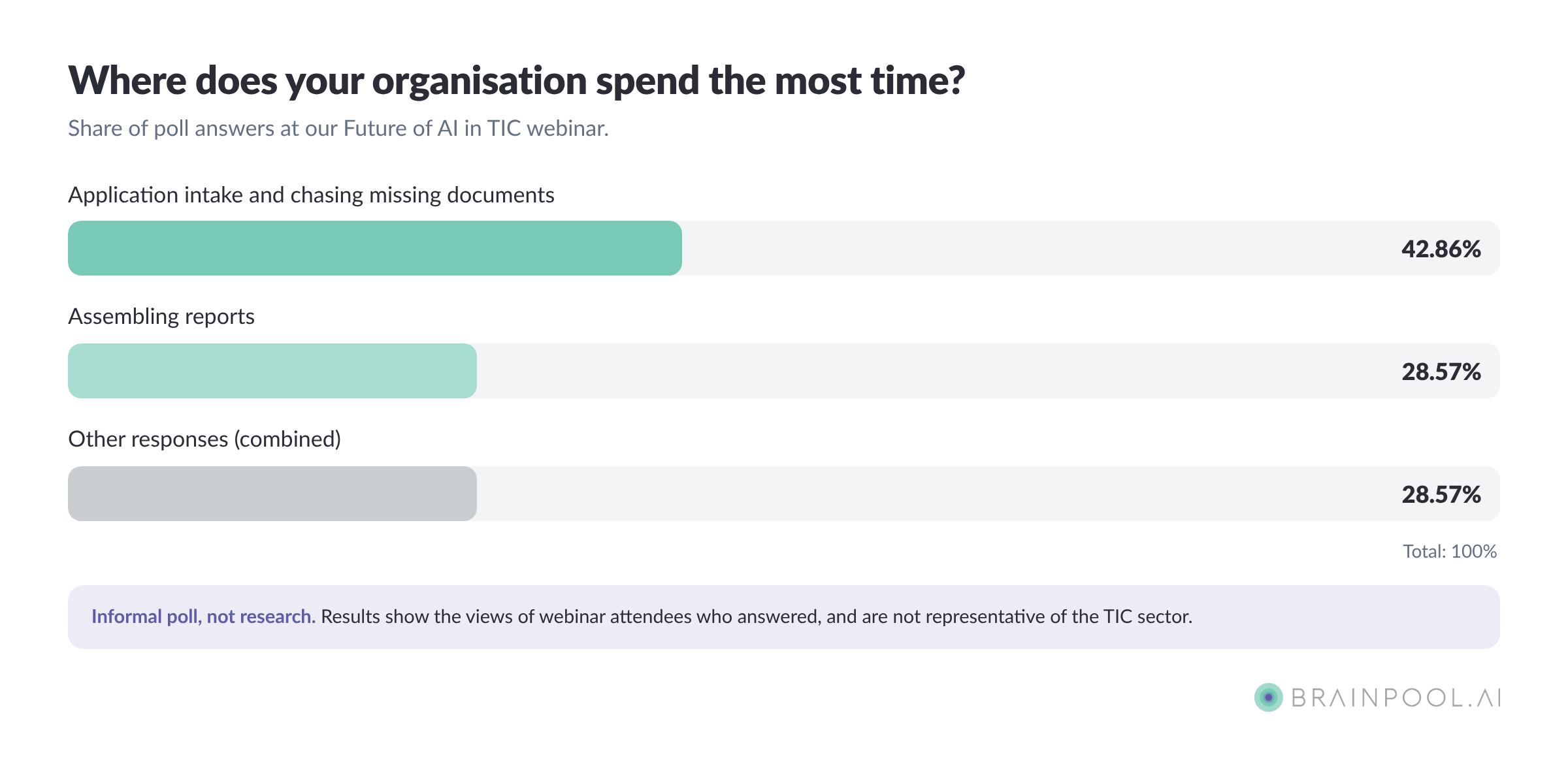
During our recent Future of AI in TIC webinar, we asked attendees where they lose time, what makes adoption difficult and what they would need from an AI solution. It was an informal poll, not sector-wide research, so we would not claim it represents every TIC organisation. However, the themes offer a useful starting point: focus on real workflows, understand the necessary controls and keep people accountable for important decisions.
Start with the work that gets in the way
Application intake and chasing missing documents came up most often when attendees were asked where they spend their time, with report preparation close behind.
These tasks matter, but they can take significant time away from where a team's specialist expertise adds most value: checking applications against requirements, spotting missing evidence, contacting applicants and checking everything again once it arrives.
An AI-supported workflow could help with the first pass. It might read submitted documents, compare them with an agreed checklist, flag what appears to be missing, organise the evidence and prepare a draft follow-up. A team member can then review the result and decide what happens next.
The same principle applies to report preparation. AI may help bring information together, create a first draft or highlight gaps for review. But drafting is not approval. The appropriate technical reviewer remains responsible for checking the content, applying their expertise and approving the final report.
Understand the concerns before choosing the technology
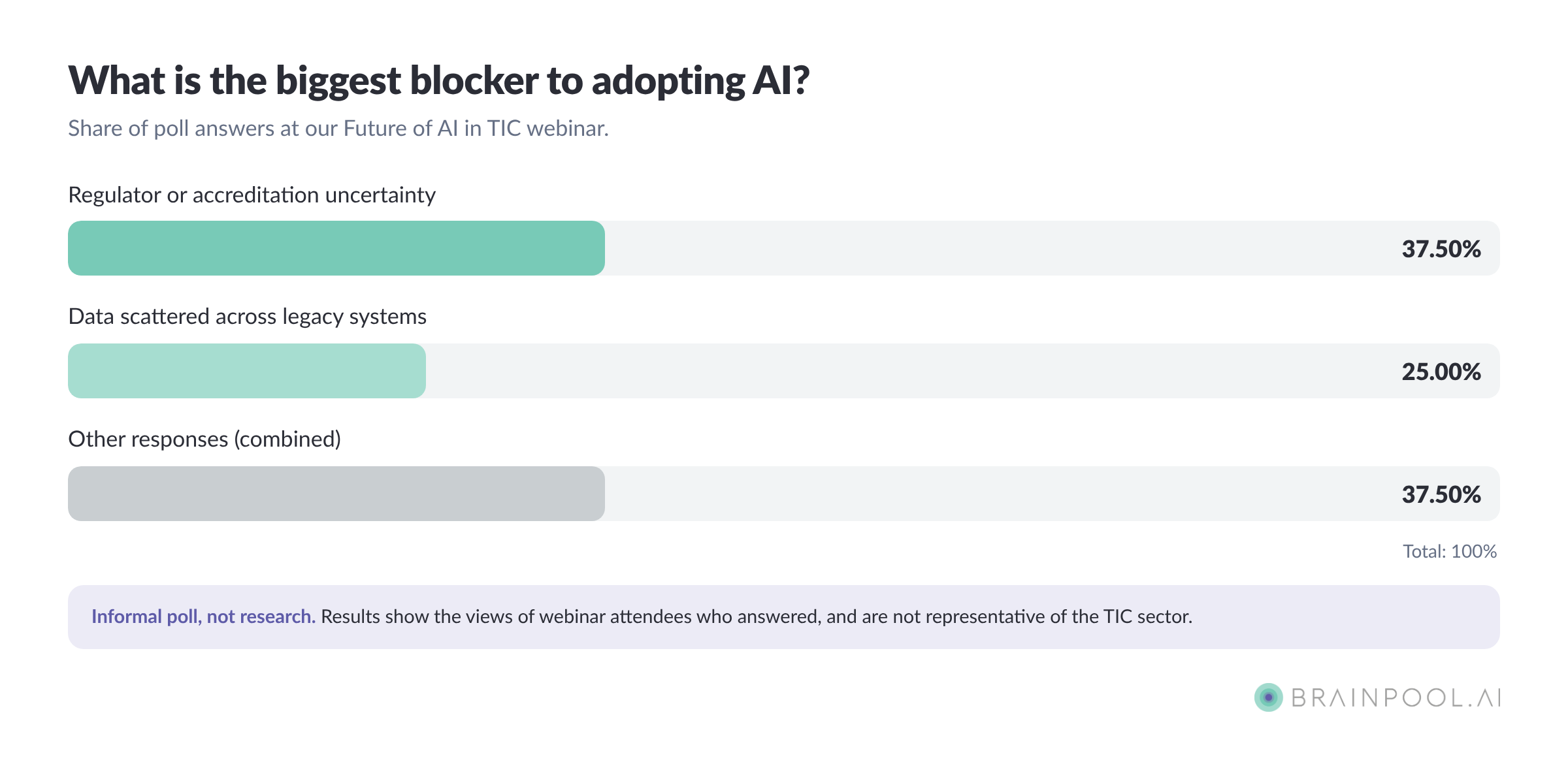
Uncertainty about what regulators or accreditation bodies might expect was the adoption concern that came up most in the webinar poll. Attendees also highlighted information being spread across legacy systems.
Those are sensible issues to address early. Requirements and expectations vary by activity, organisation and accreditation context, so there is no universal assurance that a particular AI approach will be acceptable. TIC businesses should engage with relevant bodies where appropriate and understand what evidence, validation and records they may need to demonstrate.
It is also worth considering data from the outset. Useful information may sit across a laboratory information management system (LIMS), a quality management system (QMS), a CRM, shared drives and email. An AI solution needs secure access to the right information, with appropriate permissions and controls over how it is used.
That does not mean every system needs replacing or every dataset needs cleaning before you begin. A more manageable approach is to identify the information needed for one workflow and establish how it can be accessed safely.
Human oversight needs to mean something
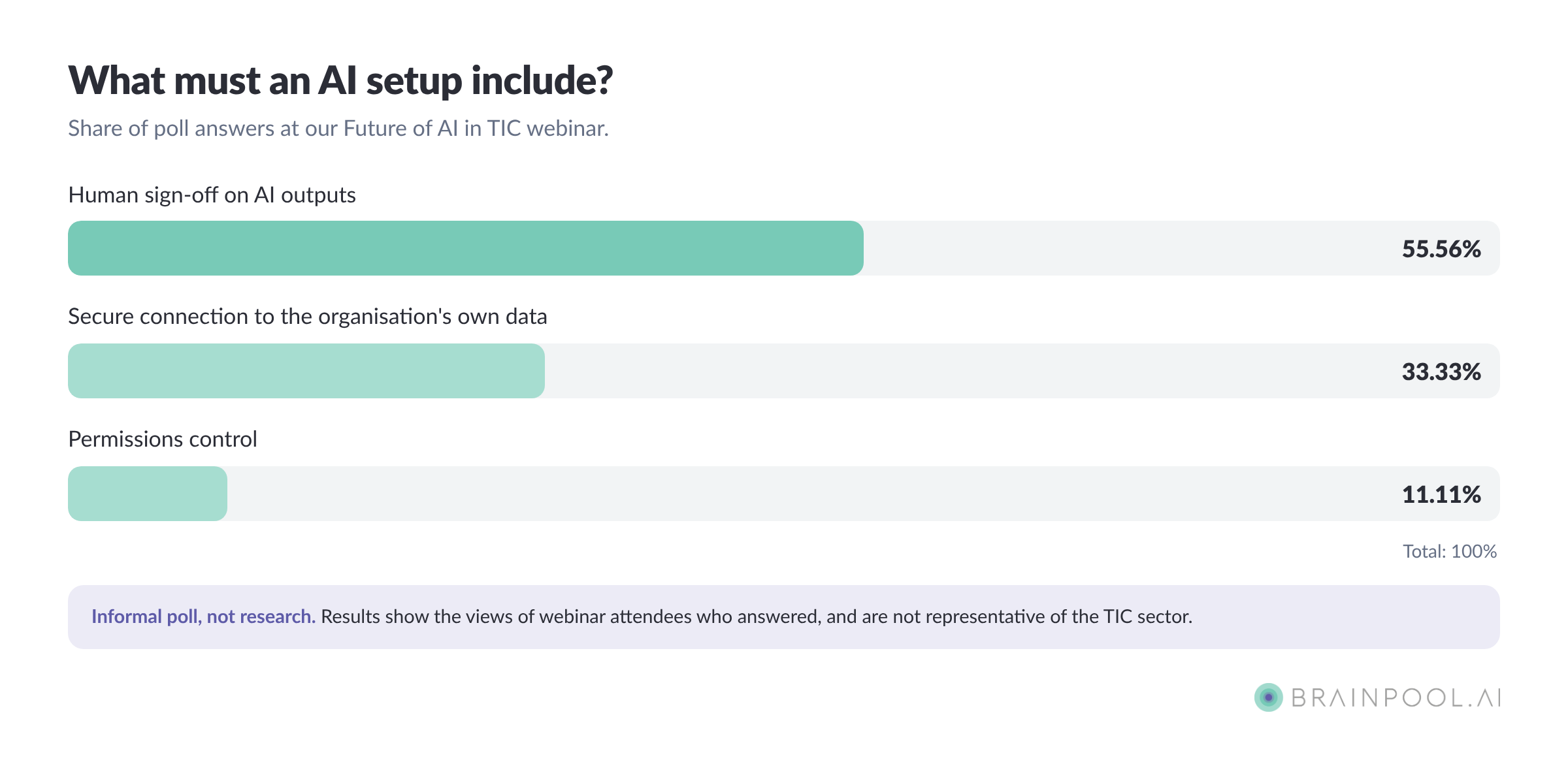
When attendees were asked what an AI setup must include, human sign-off was the clearest requirement. Secure access to an organisation's own data and permissions control were also highlighted.
Human oversight should be more than asking someone to tick a box at the end. A reviewer needs to be able to:
- See the source evidence alongside the AI-generated output.
- Understand what the system has produced, what evidence it used and what still needs checking.
- Have the knowledge and time to challenge or correct the result.
- Know who is accountable for the final decision.
The supporting controls matter too. Access should be limited to the information each workflow and user needs. Actions should be recorded where an audit trail is required. The system should also be tested, monitored and kept within clearly defined limits.
Human review does not, by itself, guarantee that an AI system is accurate, safe or compliant. It is one part of a wider approach that includes appropriate testing, security, governance and ongoing oversight.
Choose an approach that fits your organisation
There is no single right way for every TIC business to adopt AI. A packaged tool may suit a common, well-defined task, while an in-house build may work where an organisation has the skills and capacity to develop and maintain it.
But where workflows are more specialised, existing systems need connecting or the right solution isn't immediately obvious, working with an experienced AI partner can make a real difference. A specialist partner can help identify where AI will add genuine value, assess the technical requirements and develop a solution around the way your organisation already works – supporting everything from initial scoping through to integration, implementation and ongoing improvement.
Whichever route you consider, ask some straightforward questions: Where will the data go? How will people check the output? What can we configure and own? Who will maintain the solution, and what happens if the underlying technology changes?
The important thing is to choose technology around the way your organisation works, rather than forcing your people and processes to fit a tool. That means understanding the technical context, the systems already in place and the decisions that must remain with qualified people.
A sensible first step: one workflow
You do not need to begin with a large AI programme. Choose one frequent, clearly defined task that takes time, has supporting information and produces an output a competent person can review.
Application intake and document checks may be a good place to start. Preparing a first draft of a report could be another. Before building anything, agree three things:
- What a useful improvement would look like.
- Who will review the output.
- What the system must never do.
Then test it against real examples and refine the approach before relying on it in day-to-day work.
At Brainpool, we believe effective AI starts with understanding the organisation, not choosing technology for its own sake. We work with businesses to identify practical opportunities and develop solutions around their workflows, data and existing systems, establishing where AI can help – and where it should not replace human judgement.
If you have a workflow in mind, book a free consultation and bring it to us. We can explore the opportunity together, with no obligation.