
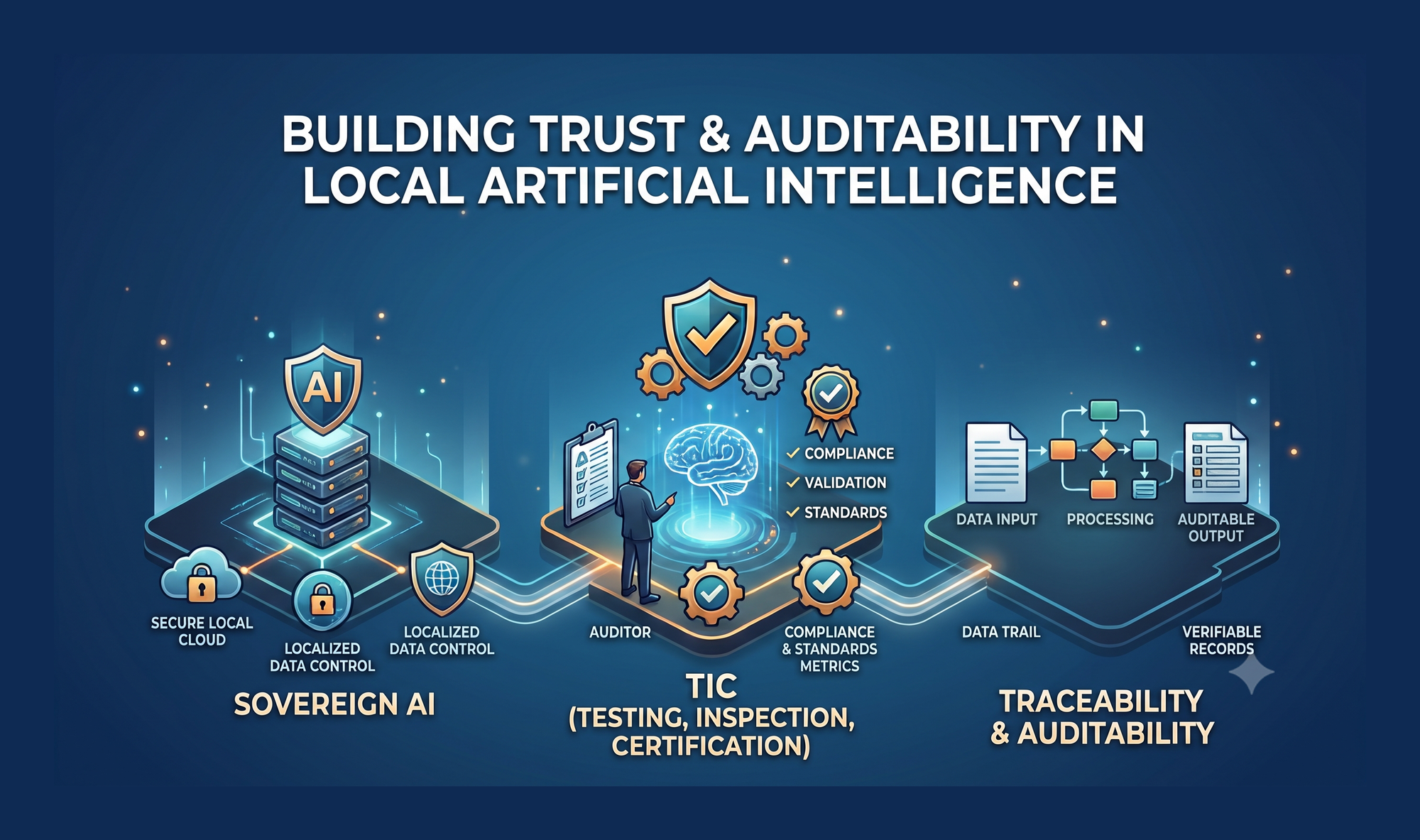
The most capable model an enterprise can legally download, self-host, and fully audit is now a Chinese open-weight system. That single fact reframes AI strategy for every Testing, Inspection & Certification firm that cannot pour sensitive client data into a closed API. But sovereignty only answers where your AI runs — not the harder question of whether you can prove what it did.
The uncomfortable fact at the top
Here is a sentence that would have sounded absurd eighteen months ago: the best model you can run entirely on your own hardware, inspect end-to-end, and never expose to a third party is not from OpenAI, Anthropic, or Google. It is Kimi, from the Beijing lab Moonshot AI.
For most consumer use, that is a curiosity. For a Testing, Inspection & Certification (TIC) business — where confidentiality clauses, accreditation rules, and client NDAs frequently forbid sending data to an external model, and where every output must be defensible to an auditor — it is the beginning of a genuine strategy question. It forces three threads together that are usually discussed separately: the arrival of open-weight models at the frontier, the rise of sovereign AI, and the unglamorous but decisive determinism problem — the fact that AI systems don't reliably do the same thing twice, and regulated industries cannot live with that unless it is made traceable.
This piece works through all three, and then does the part most commentary skips: it connects them to the specific, four-layered regulatory reality of the TIC sector.
1. The new Kimi model — an open-weight system at the frontier
Moonshot AI spent 2025 and 2026 executing one of the more remarkable comebacks in the field, largely by open-sourcing frontier-adjacent models. The lineage matters, because the trajectory is the story:
Table 1 — The Kimi K2 family
| Model | Released | Architecture | What it added | Headline result |
|---|---|---|---|---|
| Kimi K2 | Jul 2025 | 1T params / 32B active, 384-expert MoE | First frontier-adjacent open release; Modified MIT license | State-of-the-art open-model coding scores (leanware) |
| Kimi K2 Thinking | Nov 2025 | + reasoning, native INT4, 256K context | Interleaves chain-of-thought with 200–300 tool calls | First open model to claim SOTA vs closed models (digitalapplied) |
| Kimi K2.5 | Jan 2026 | + MoonViT vision encoder | Native multimodality; Agent Swarm (≤100 sub-agents) | Native multimodal, four operating modes (AIwire) |
| Kimi K2.6 | Apr 2026 | 1T params, INT4, ~594GB footprint | Agent Swarm scaled to 300 sub-agents | Ties GPT-5.5 on SWE-Bench Pro (58.6%) at ~⅓ the cost (miraflow) |
| Kimi K3 | Jul 2026 | 2.8T params, 1M context, native vision | Largest open-weight model to date | Entered the frontier pack in blind testing (Tom's Hardware) |
The pivotal release was Kimi K2 Thinking in November 2025 — the first open-weights model to post state-of-the-art numbers against closed frontier systems on the benchmarks that actually map to work: agentic tool use, autonomous browsing, and software engineering. On BrowseComp, which measures multi-step autonomous web research, it did not merely keep pace with closed models — it led them, and cleared the human baseline by a wide margin.
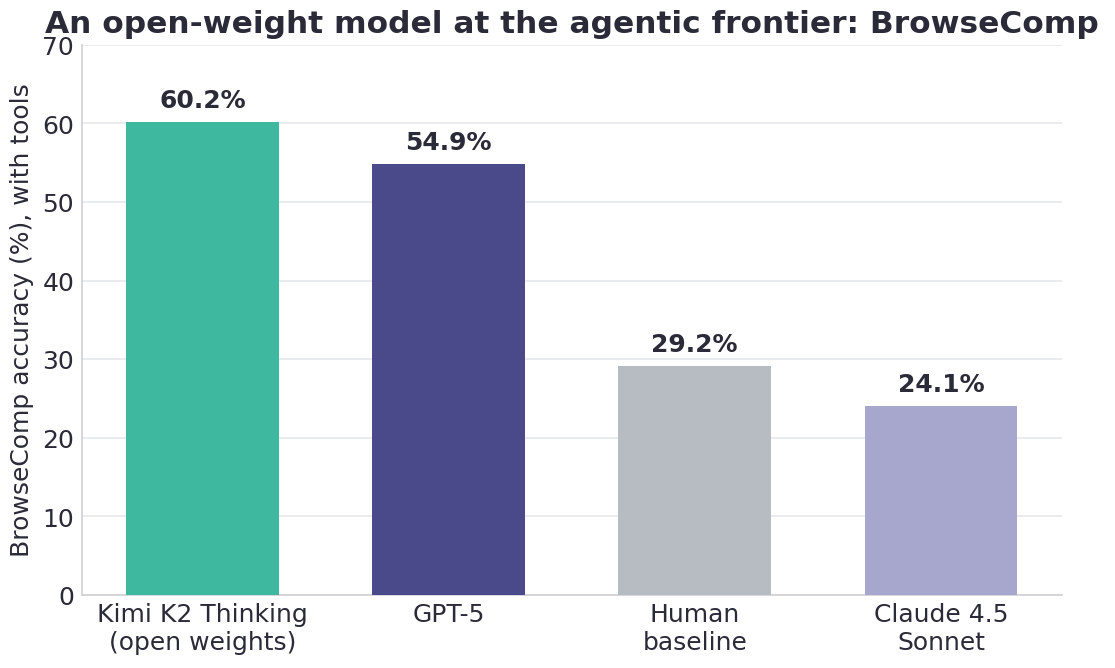
Figure 1 — On agentic web-browsing, an open-weight model leads the closed frontier (source).
Table 2 — Selected Kimi benchmark scores
| Benchmark (higher = better) | Kimi score | Comparison | Source |
|---|---|---|---|
| BrowseComp (agentic browsing) | 60.2% (K2 Thinking) | GPT-5 54.9%; Claude 4.5 Sonnet 24.1%; human 29.2% | digitalapplied |
| Humanity's Last Exam, with tools | 44.9% (K2 Thinking) → 54.0% (K2.6) | Among the hardest knowledge benchmarks | digitalapplied / miraflow |
| SWE-Bench Verified | 71.3% (K2 Thinking) | Competitive with frontier closed models | digitalapplied |
| SWE-Bench Pro | 58.6% (K2.6) | Ties GPT-5.5 | miraflow |
Two properties turn this from a leaderboard headline into an infrastructure decision. First, you can run it yourself. K2.6 uses native INT4 quantisation that shrinks the footprint to roughly 594GB (down from ~1TB at full precision); a viable deployment starts around 4× H100 GPUs, with full 256K context recommended on 8× H200 — meaning, as one analysis put it, a well-resourced team can realistically self-host it, and "that matters for data sovereignty." Second, it is dramatically cheaper. K2.6 is priced around $0.95 / $4.00 per million input/output tokens against GPT-5.5's $2.50 / $15.00.
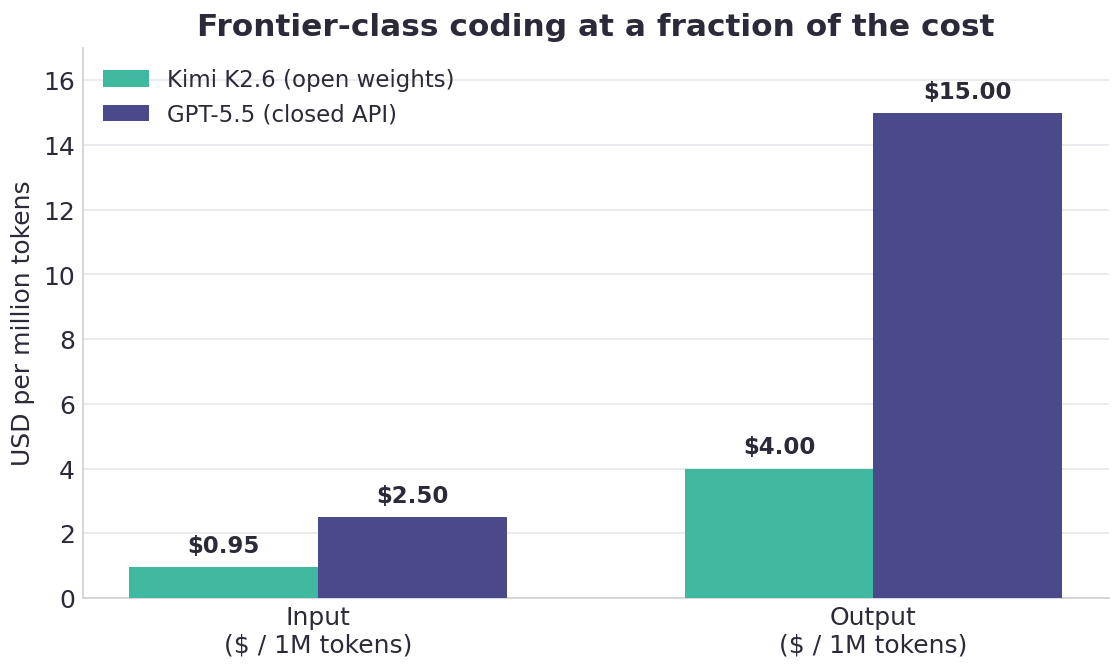
Figure 2 — Frontier-class coding at a fraction of the price. Kimi K2.6 ties GPT-5.5 on SWE-Bench Pro (58.6%) while costing roughly a third per token, and up to ~8× less on output. Source: miraflow.ai (Apr 2026).
The honest caveat: Kimi is a coding and agentic specialist, not a universal frontier generalist. On broad general-intelligence indices, top closed models still lead, and Kimi's multimodal performance lags. The Modified MIT license behaves like standard MIT below thresholds (100M monthly active users or $20M monthly revenue) no TIC firm will ever approach. The strategic point is simpler than any single benchmark: the most capable model you are legally allowed to own is now good enough to matter — and it happens to be Chinese and open.
2. Sovereign AI — from "data residency" to owning the stack
"Sovereign AI" has escaped the think-tank circuit and landed on boardroom agendas. The reason is not ideology; it is exposure. And the most important thing to understand about it in 2026 is that most organisations define it wrong.
Choosing "AWS Frankfurt" and calling your data sovereign is a category error while the US CLOUD Act still reaches American providers wherever they host. Real sovereignty is a deployment pattern, not a region setting, and it rests on four things: infrastructure you control; a hard data boundary the data never crosses; open-weight models you can self-host and audit indefinitely; and the internal ability to fine-tune without shipping training data into a foreign pipeline. Only the third of those is a model decision — and it is the one that makes the other three possible. You cannot air-gap, inspect, or indefinitely retain a closed API.
Governments have moved structurally. At the Paris AI Action Summit in February 2025, the European Commission launched InvestAI, a €200 billion mobilisation including €20 billion for four to five "AI gigafactories," each envisaged with around 100,000 next-generation chips — framed explicitly as a "CERN for AI" for European technological sovereignty. Alongside it sit GAIA-X, the proposed EuroStack, sovereign-cloud builds from Deutsche Telekom, and AWS's isolated European Sovereign Cloud. The demand signal is real: German industry surveys through 2025–2026 show a large majority of firms judging the country over-dependent on US cloud providers.
Here is the paradox that makes this a live decision rather than a slogan. The best open source now comes largely from China. Hugging Face's State of Open Source Spring 2026 report found that, over the past year, "Chinese models quickly accounted for the plurality or 41% of downloads," surpassing the US for the first time. TechCrunch reported in July 2026 that on the OpenRouter routing platform the top six most popular models are all Chinese open weights — from Tencent, Xiaomi, DeepSeek, MiniMax, and Z.ai — with Anthropic's Claude Opus 4.7 trailing in seventh, while open models absorbed nearly a third of AI requests on Vercel in June.
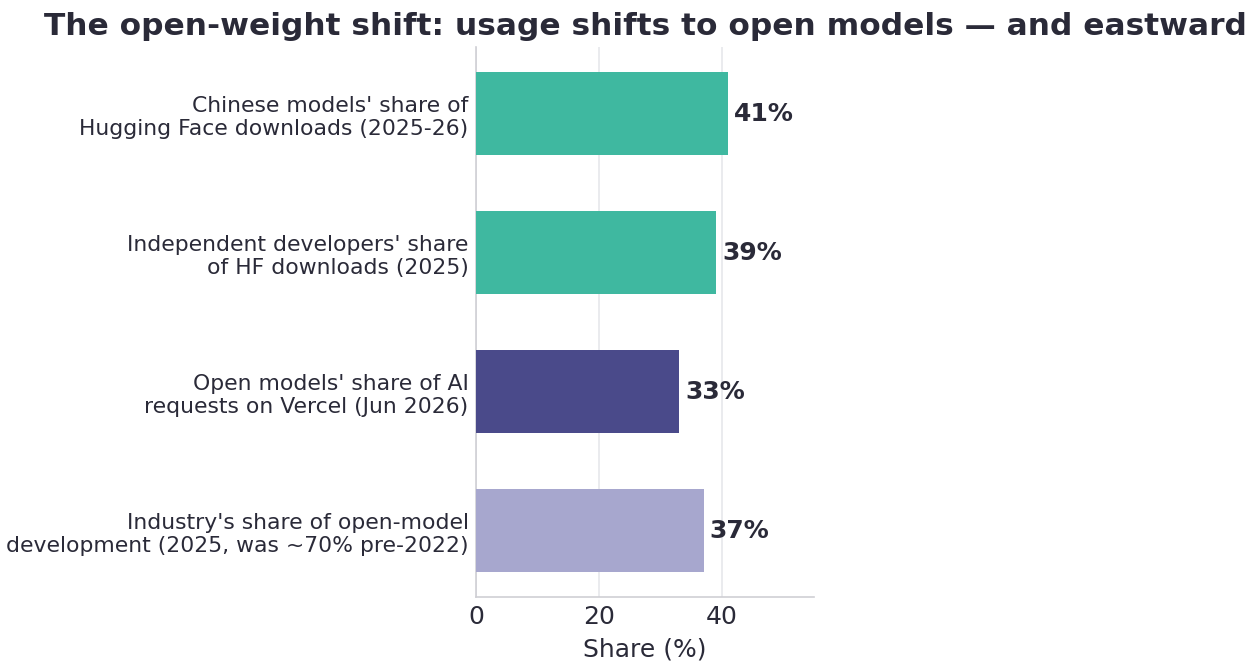
Figure 3 — Usage is shifting to open models, and eastward: Chinese models now take 41% of Hugging Face downloads, and the top six models on OpenRouter are all Chinese open weights (Claude Opus 4.7 is 7th). Sources: Hugging Face, 'State of Open Source' Spring 2026; TechCrunch (Jul 2026).
The geopolitics are genuine and cut in two directions — governments on both sides have signalled interest in restricting cross-border access to advanced models. But the crucial distinction for a compliance-minded buyer is this: running Chinese open weights, air-gapped and inspected, on your own hardware is a fundamentally different risk posture from calling a China-hosted API. Open weights already mirrored and fine-tuned worldwide cannot be un-released; and self-hosting removes the data-exfiltration vector entirely, leaving only training-data provenance and output-safety concerns — which is precisely what an inspection and traceability layer exists to manage, regardless of where the model came from.
3. The determinism problem — why traceability is the real bottleneck
Sovereignty answers where the model runs and who can see the data. It does nothing about the harder question in any regulated setting: can you prove what the model did, and would it do the same thing again?
The uncomfortable answer, laid out sharply in the essay "The Determinism Problem", is that agent systems typically reach production in a state that is hard to describe honestly: they work often enough to justify the spend, fail rarely enough to resist diagnosis, and vary just enough between runs to make every incident expensive. Two identical requests can take different paths to different answers, and neither trace explains why.
And — this is the part most teams miss — it is not just the model's sampling. Even at temperature zero, production LLM inference is non-deterministic. Thinking Machines Lab (founded by former OpenAI CTO Mira Murati) demonstrated that the primary culprit is batch-level variability: because common GPU kernels aren't "batch-invariant," an individual request's output depends on how many other requests happen to be batched with it — which is effectively random from the user's perspective. Layer on top of that the ordering of tool returns, cache hits, retry timing, and retrieval-ranking ties, and reproducibility quietly dies.
The fix is not "a better model." It is a deterministic execution and audit layer wrapped around the model: strict event ordering under a single authority, materialised snapshots at each turn boundary, tools treated as state-bound events with idempotency keys, and versioned writes. The goal is not to make language generation mathematically deterministic — it is to make the surrounding computation deterministic enough that model variation becomes visible and replayable rather than mixed into orchestration noise. As the essay puts it, this "turns an opaque sequence of plausible actions into a state machine that can be recovered, audited and compared."
This is not engineering hygiene for its own sake. It is the difference between an operational system and a convincing demo — and, increasingly, a compliance requirement. As one industry write-up on the coming reproducibility crisis warns, teams shipping LLMs without reproducibility infrastructure are "constructing an audit defense problem they don't yet recognise." The lowest-effort, highest-leverage first move is unglamorous: start with the audit trail. Persist the prompt, the model version, the inputs, the tool calls, and the intermediate state for every AI-assisted output — enough to reconstruct any single decision on challenge. Emerging techniques go further (checkpoint-based state replay, batch-invariant kernels, full trajectory persistence), but the audit trail is the floor.
4. Why traceability and sovereignty matter specifically in TIC
TIC is a trust industry. Its entire product is a signature that says this was tested, inspected, or certified, and you can rely on it. That makes uncontrolled, non-reproducible AI not a compliance nuisance but an existential risk — and it is why the sector sits at the exact intersection of everything above. Four regulatory regimes stack on top of each other simultaneously, and every one of them points at traceability and human authority.
Table 3 — The four-regime regulatory stack facing AI in TIC
| Regime | What it requires | Implication for AI |
|---|---|---|
| ISO/IEC 17025 / 17020 / 17065 (accreditation) | Metrological traceability, data integrity, and reports reviewed and authorised by competent, named personnel | AI may draft and assist; the authorised signatory must remain accountable and able to reproduce the basis of any output |
| UKAS / DAkkS AI guidance (UKAS Jun 2025; joint bulletin Mar 2026) | AI adoption is a "significant change" requiring notification; human oversight and competence to evaluate outputs | "Final decisions on conformity may not be delegated to AI systems" — this is explicit |
| EU AI Act (Article 12) | High-risk systems must automatically log events "over the lifetime of the system" for traceability; conformity assessment | Off-the-shelf APIs do not produce Article 12–grade decision logs by default; deployers carry the record-keeping duty |
| GxP data integrity (ISPE GAMP AI Guide, Jul 2025) — ALCOA+, 21 CFR Part 11, EU Annex 11 | Attributable, tamper-evident, time-stamped audit trails; validation of AI's non-deterministic behaviour | For TIC firms serving pharma/med-device clients, every prompt and output becomes a GxP record with full traceability |
Notice how consistent the direction is. ISO/IEC 17025 requires that the person authorising a result be competent and authorised — the report must trace to the underlying data, method, and equipment. The joint UKAS/DAkkS bulletin is blunt that the final conformity decision may never be delegated to AI, and that adopting AI is a significant change you must notify. The EU AI Act's Article 12 makes lifetime event-logging a legal obligation for high-risk systems — and conformity assessment is itself a core TIC activity, which means TIC firms are simultaneously users of AI and assessors of everyone else's. And the new ISPE GAMP AI Guide confronts the determinism problem head-on, noting that AI produces non-deterministic outputs and must therefore be validated on statistical performance under varied scenarios rather than fixed code-path testing. Governance frameworks like ISO/IEC 42001 and the NIST AI RMF sit over the top.
Put the pieces together and the architecture almost designs itself. A TIC firm usually cannot send confidential test data, proprietary methods, and pre-publication findings to a closed third-party API — confidentiality and impartiality clauses forbid it, and the logging and data-integrity duties require control the firm does not have over a black box. Simultaneously it must be able to reproduce and audit exactly what any AI did, with a competent human holding the pen on the final decision. That is not a wish list. It is a specification:
- Sovereignty — a self-hostable open-weight model (Kimi today; a Western open model tomorrow) keeps data inside the perimeter.
- Determinism / traceability — a deterministic execution and audit layer makes every step replayable and every output attributable.
- Human authority — the accredited signatory authorises the report; the AI never closes the loop.
The delegation chain — every AI action attributable to a human authoriser in a tamper-evident record — is the evidentiary bridge between agentic AI and accreditation. It is also, not coincidentally, exactly what Article 12 and ALCOA+ are asking for.
5. Where this leaves the model layer — and Brainpool Cortex
If the durable value sits in the audit and determinism layer, then the model itself is a commodity that should be swappable. This is the single most important architectural conclusion, because the frontier is moving monthly: Kimi K2 → K2 Thinking → K2.5 → K2.6 → K3 in a single year, with DeepSeek, Qwen, Llama, Mistral, and Z.ai leapfrogging each other in between. Any firm that hard-wires itself to one model — open or closed — is rebuilding its compliance posture every quarter.
This is precisely the pattern Brainpool Cortex is built around: a model-agnostic agentic platform deployed inside the client's own cloud — "your data, in your environment" — that adopts open-source models where they fit, swaps in new frontier models as they ship, and transfers full IP ownership to the client to "avoid vendor lock-in entirely." Brainpool's own TIC writing has made the same argument the determinism literature makes — that in accredited work, accuracy and auditability outrank raw speed — and its TIC sector analysis frames agentic AI as a back-office transformation governed by human oversight, not a replacement for the accredited professional. A firm that owns a robust audit/determinism layer can run Kimi today and something else next year without touching its accreditation story.
6. What to do about it
For TIC executives (next 0–6 months)
- Inventory every point where AI touches an accredited process and classify each by reliance level — administrative, advisory, decision-support — using the UKAS/DAkkS taxonomy. Notify your accreditation body: AI adoption is a significant change, not a quiet upgrade.
- Draw the line in policy and in architecture: AI is decision-support; the accredited signatory authorises the report. Never delegate the conformity decision.
- Stand up the audit trail before optimising anything else. Persist prompt, model version, inputs, tool calls, and intermediate state for every AI-assisted output. This one move simultaneously advances EU AI Act Article 12, ALCOA+, 21 CFR Part 11, and Annex 11.
For PE investors and operating partners
- Make "can this be self-hosted and audited?" a diligence gate for any AI vendor selling into a TIC portfolio company. A closed API with no reproducibility story is a latent liability that can impair an accredited scope.
- Value the horizontal lever: a sovereign, traceable, model-agnostic platform deployed once and rolled across a portfolio compounds — but only if it is audit-native by design.
For enterprise architects
- Default to a sovereign open-weight model behind your own boundary for sensitive workloads; reserve external APIs for low-consequence, non-sensitive tasks under explicit written rules. Benchmark on your tasks, not leaderboards.
- Build the deterministic execution layer first and treat it as durable infrastructure — ordered events, turn-boundary snapshots, idempotent tools, versioned writes, full trajectory persistence — with the model as a swappable component.
Caveats worth stating plainly
- Benchmarks over-promise. Many Kimi figures are vendor-reported, and benchmark saturation means small leaderboard gaps rarely survive contact with real workloads. Test on your own data.
- The version numbers will date fast. K2.6, K3, GPT-5.5, Claude Opus 4.8 reflect a mid-2026 snapshot; the specific ranking will shift within months. The strategic argument — open weights at the frontier, sovereignty plus traceability — is what's durable.
- Chinese-model risk is real but manageable. Documented concerns include output censorship and training-data provenance; self-hosting removes the data-exfiltration vector but not those, which is exactly why the inspection and traceability layer matters regardless of a model's origin. Running Chinese weights on a Western SOC-2 host is a different posture again from a China-hosted API.
- Sovereignty has a cost. Self-hosting a trillion-parameter model shifts GPU, power, and ops burden onto you; it pays off mainly at sustained scale. Smaller firms should size to the use case and route only non-sensitive tasks externally.
The window is open because the first wave of AI in TIC went into lab instruments and field inspection, not the coordination and reporting layer where confidentiality, traceability, and human authority collide. That is the layer that is hardest to get right — and therefore the one that builds the most durable advantage. The firms that treat the model as swappable and the audit layer as the asset will be the ones whose AI still stands up when the assessor asks the only question that has ever mattered in this industry: show me how you know.
Brainpool AI builds Cortex, a model-agnostic agentic platform deployed inside your own environment, purpose-built for regulated sectors including Testing, Inspection & Certification. To discuss sovereign, auditable AI deployment across a TIC portfolio, get in touch.